
Case Study: IdeaPanda
IdeaPanda finds business ideas worth building by scanning real complaints from Reddit, app reviews and forums, scoring each one with a 0–100 Signal Score, and shipping it with a full research report — competitors, pricing math, and the exact communities where the first customers are already waiting. $24, once, for lifetime access.
The mechanic wasn’t the problem — our whole team agreed the demand-backed angle is the product’s real moat. What we found instead, once we ran our own social listening report on top of theirs, is that the single biggest founder pain cluster we identified — bigger than idea validation, bigger than wasted build time — was one the page never said out loud: the silence that follows a launch nobody shows up for. IdeaPanda already had the answer to that fear, buried in a single feature bullet. Here’s how we found the gap, what we pulled from Reddit, the full feedback board from our two-human-one-AI review, and the hero we ended up shipping.
Part 1: The First AI Pass
Every URL we take starts with a blind read. Our crawler digests the page before any of us forms an opinion, so we start from facts instead of vibes.
For IdeaPanda, it came back with a clean picture:
- What it is: a database of business ideas sourced from real public complaints — Reddit threads, app store reviews, forum posts — ranked by demand and refreshed daily.
- The core idea: skip the guessing game. Every idea ships with a Signal Score out of 100, built from five factors — momentum, demand spread, pain clarity, whitespace, and buildability — plus a full research report on competitors, pricing, and risk.
- The differentiator nobody was shouting about: every report also points to the exact communities where the demand came from, meaning a builder doesn’t just know what to build — they know exactly where their first customers are already hanging out.
- Pricing: $24 for lifetime access, pitched directly against IdeaBrowser ($499/year) and IdeasAI (ideas invented by a prompt, not sourced from a real complaint).
It’s a sharp, well-priced product with a real data moat behind it. But this first pass only tells us what IdeaPanda has — not which fear it’s actually built to kill.
Part 2: Two Candidate Audiences, One Real Buyer
From the feature set and language patterns, the engine surfaced two clear profiles:
- The Side-Hustle Developer — codes on nights and weekends, cares about shipping something people actually want, and dreads falling in love with an idea, building it in secret, and launching to nothing.
- The Serial Indie Hacker — has already shipped a few things, wants clean data, competitor whitespace and monetization math, and mainly wants to stop burning hours on manual Reddit scans or custom scraping stacks.
Why we set the serial indie hacker aside
This is exactly where automated tools fail. An AI reviewer tries to write copy that pleases both profiles at once, and ends up speaking to neither.
The call was easy. The serial indie hacker is a real, valuable user, but he’s already halfway convinced — he just wants proof the data is clean and the whitespace is real. He converts on rigor, not on emotion.
The Side-Hustle Developer is the one who needs to feel understood before he’ll trust a database with his next few months. So we pointed the whole audit at him. We’ll call him Martin.
Part 3: Finding Martin’s Voice on Reddit
Once we know who we’re writing for, we go find how they actually talk. We ran our own social listening pass across r/SaaS, r/indiehackers and r/startups: 341 posts analyzed, narrowed to ~100 posts across four pain clusters, down to 27 selected verbatims representing 15,997 points of cumulative engagement.
Three of the four clusters were already reflected somewhere on the page:
- Idea Validation Failures (~30 posts) — time wasted trusting AI or Reddit “vibes” instead of real signals. Covered, in the “not invented by AI” pitch.
- Developer Recruitment Pitfalls (2 posts) — money lost to bad freelance developers. Covered, tangentially, by the build-cost framing.
- Wasted Build Resources (~27 posts) — months and money sunk into features or products nobody used. Covered, in the “real demand, not guesses” pitch.
The fourth cluster was the one that stopped us: Acquiring First Users — the largest cluster we found, at roughly 45 identified posts and 4,740 engagement points in our selection — and it was a gap. Nowhere on the page did IdeaPanda say anything about it directly, even though one of its own feature bullets, “Where your first customers are,” is sitting right there as the answer.
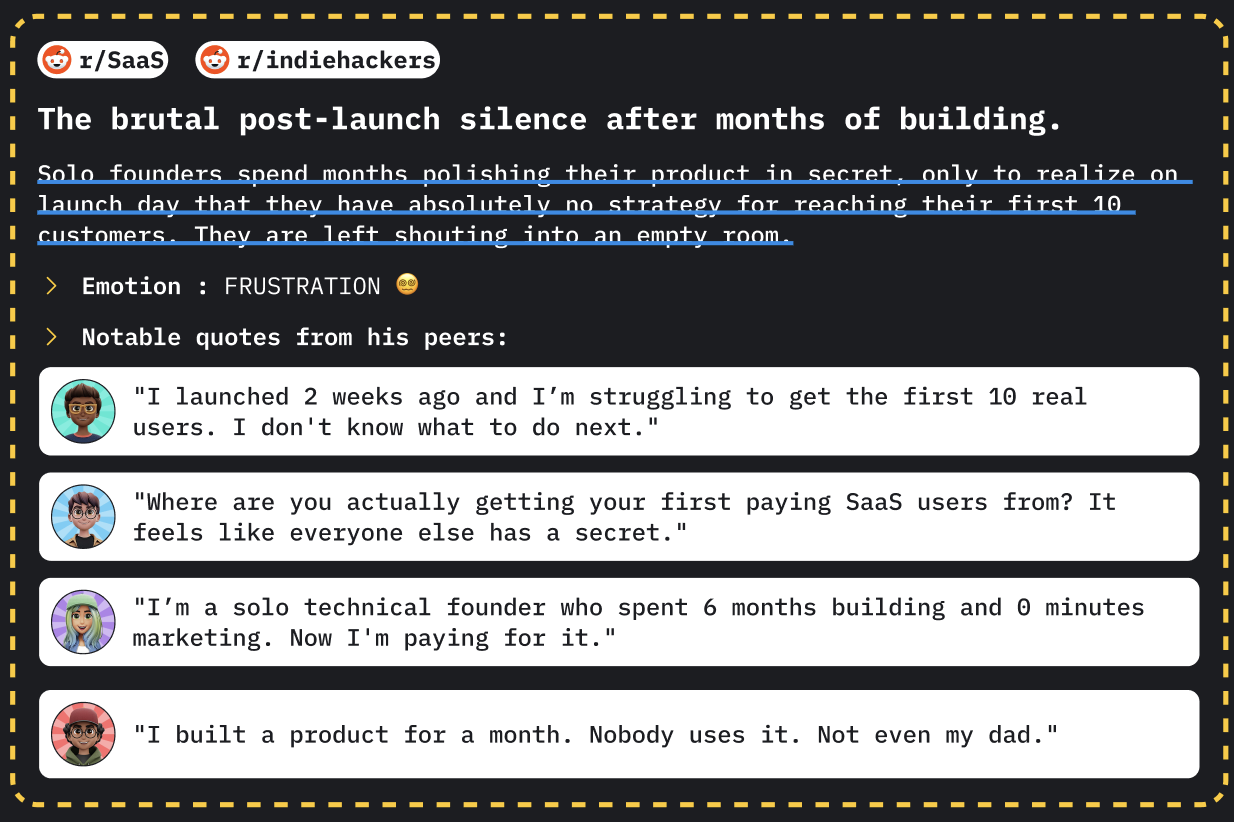
The pain point we selected: “The brutal post-launch silence after months of building.” Solo founders spend months polishing a product in secret, then reach launch day with no plan for reaching their first 10 customers — and end up shouting into an empty room. Painlevel 5. Recurring. Pure frustration.
Read the mood from Martin’s peers:
“I built a product for a month. Nobody uses it. Not even my dad.” — r/indiehackers
One founder, two weeks post-launch, admitted he was “still struggling to get the first 10 real users” and had no idea what to try next.
Another asked where everyone else was actually finding paying users, because it felt like “everyone else had a secret” he wasn’t in on.
A third put a number on the regret directly: six months building, and “zero minutes spent on marketing” — now paying for that choice.
The emotion here isn’t doubt about the idea. It’s the dread of being right about the idea and still hearing nothing back. IdeaPanda already answers this — every report names the exact threads and communities the demand came from. The product had the cure. The page just never said the sentence Martin actually needed to hear.
Part 4: Reading the Page Through Martin’s Eyes
With Martin’s fear in mind, we went back to the page and put our notes straight on top of the layout, where you can see what we mean rather than reading a disconnected doc.
The product was strong. The page had two specific leaks:
- The biggest differentiator was one bullet among six. “Where your first customers are” — the single line that most directly answers the uncovered fear — sat at the same visual weight as “one payment, yours forever.” It needed to be in the hero, not the fine print.
- The page explains what the product is, but not enough of why it works. The mechanics are all there — Signal Score, research reports, competitor landscape — but a first-time visitor still has to piece together why a complaint-sourced idea beats a chatbot-invented one. That gap is exactly what lets a catchy-but-abstract headline slip through instead of a descriptive one.
Part 5: The Three-Way Review (Our Full Board)
To make sure we weren’t tunnel-visioning, we ran our usual review. Yoanna looked at the flow, Aymeric at the structure and CRO — and we split our general feedback board into three main areas of discussion.
Positive points:
- Aymeric on pricing: “In a highly competitive market, your low price is a major advantage. You’re targeting side-project builders on a tight budget who are often new to indie hacking. If you can convey high product quality at this lower price point, it’s an easy win.”
- Aymeric on brand power: “Your brand name is much more friendly and approachable than the competition. Lean into this and push your mascot forward—in a highly sanitized market, having a unique personality is a huge differentiator.”
- Yoanna: “The product solves a problem we’ve all encountered as builders. (Especially beginners who are afraid of wasting time on a project that might not pay off—that’s a real concern!) You have an attractive price point and an active community on X that perfectly matches your target audience. By the way, I think you could talk even more about what you do and occasionally share a sneak peek of what an idea might look like. (Just a suggestion :))”
Notice where this lands: neither of us flagged the mechanic, the price, or the brand as the weak point. Everything already working is a genuine asset. The gaps were all downstream of the story, not the product.
Points to review (in our opinion)
- Aymeric: “You’re a data scientist. You’re building a data product. Talk about it—it’s an advantage that some of your competitors don’t have!”
- Yoanna: “In my opinion, what’s really missing is a more detailed explanation of what your tool does. Your page is already well-optimized; if you can demonstrate the value of your product and provide a little more social proof, it could really take off!”
Points to clarify:
This is the column that changed the brief.
- Aymeric: “Your positioning. All your competitors focus on idea generation and validation. You, on the other hand, have the insight to talk about finding your first users—that’s incredibly smart, and it’s what sets you apart from the rest! Unfortunately, it’s not highlighted enough! That’s a problem.”
That single note lines up exactly with what our own social listening pass had already flagged in Part 3: “Acquiring First Users” was the largest, least-covered pain cluster we found — and the page’s own best answer to it was sitting in a feature bullet nobody was reading first.
The fix
Not a page reorder. One promotion: take the line that already exists, buried mid-page, and say it in the very first thing Martin reads.
Part 6: The Hero We Shipped
Once you put it together — the engine’s read, our own social listening report, Martin’s exact words from Reddit, and the feedback board — the rewrite stops being a guessing game. Here’s the before and after we shipped:
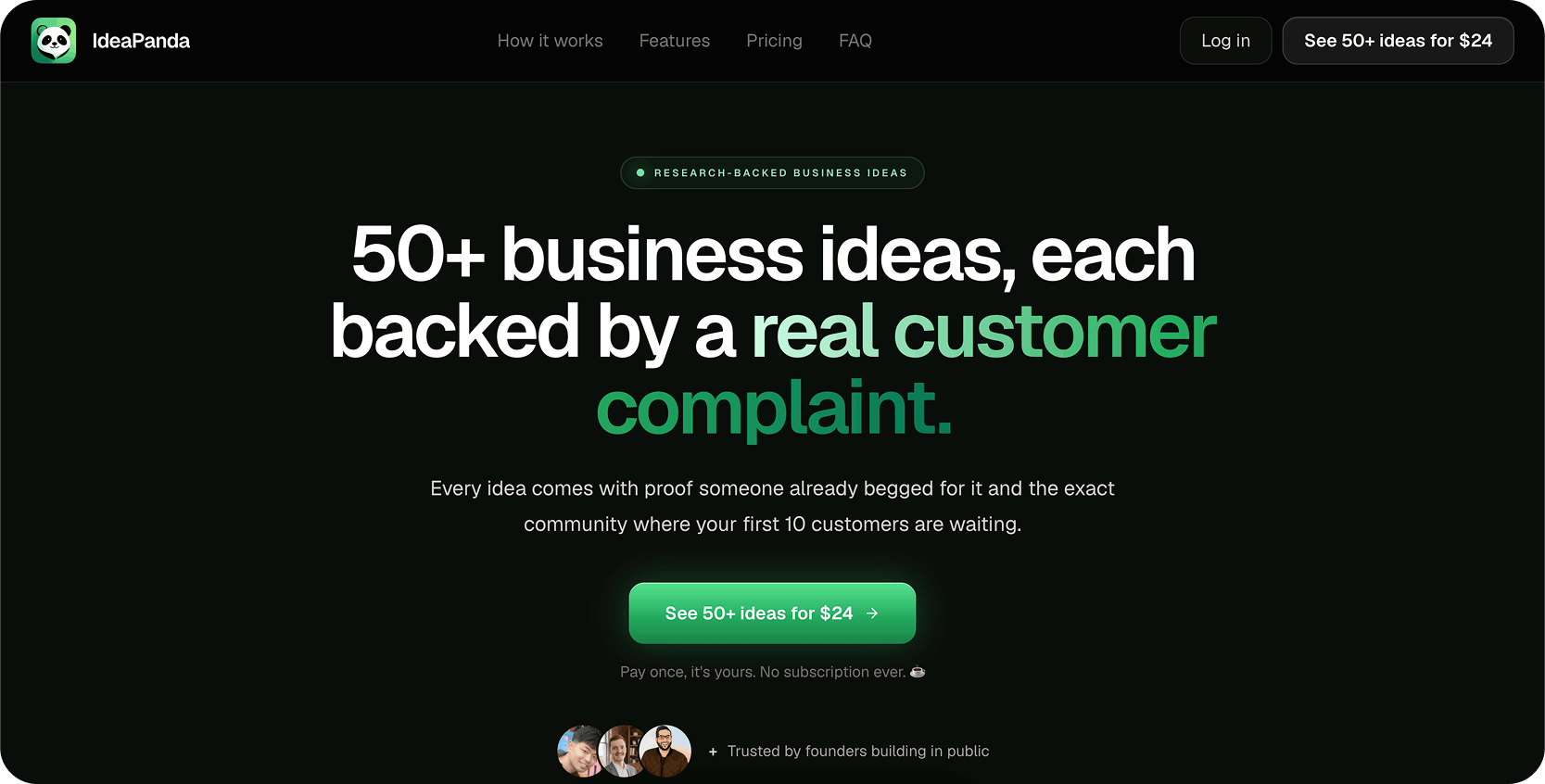
Before:
H1: Build something people already begged for.
Subhead: Every idea starts from a real complaint someone posted on Reddit, in app reviews, or on forums. The demand is there before you write one line of code.
Primary CTA: See 50+ ideas for $24 Microcopy: Pay once, it’s yours. No subscription ever.
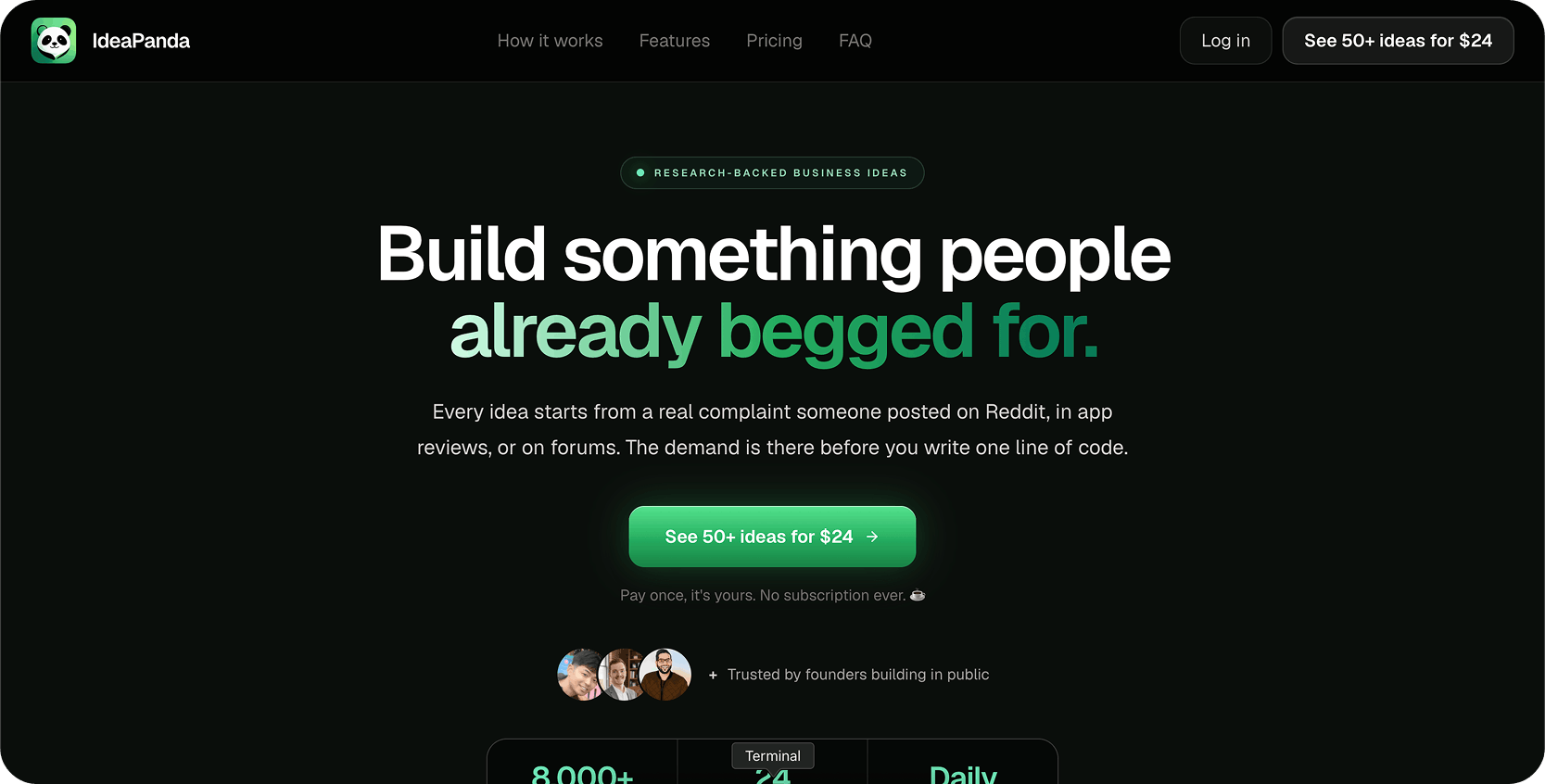
After:
H1: 50+ business ideas, each backed by a real customer complaint.
Subhead: Every idea comes with proof someone already begged for it and the exact community where your first 10 customers are waiting.
Primary CTA: See 50+ ideas for $24 Microcopy: Pay once, it’s yours. No subscription ever.
Why each line earns its place
- The new headline is descriptive, not just catchy. As Aymeric put it: “‘Build something people already begged for’ is catchy but abstract. The new header passes the Shapiro test: reading it alone tells you exactly what you’re buying – 50+ sourced ideas.” The original line was memorable, but it made Martin work to figure out what he’d actually get for $24.
- The subhead finally promotes the buried differentiator. “We are highlighting your key differentiator, distribution, which is a strong selling point to emphasize,” as Aymeric noted. “The exact community where your first 10 customers are waiting” takes the one line Aymeric flagged as under-highlighted in the “points to clarify” column and puts it in the first paragraph Martin reads.
- The CTA and microcopy didn’t move. “See 50+ ideas for $24” and “Pay once, it’s yours” were already doing their job — the fix wasn’t about pushing harder, it was about telling Martin exactly what he’s buying and why it’s different, before he even reaches the button.
Same product. Same price. We just swapped an abstract slogan for a descriptive headline, and gave the differentiator that was already winning the internal review a line in the hero instead of a bullet six scrolls down.
See the Full Audit
Everything above lives in one place. Here’s the complete, interactive audit we delivered — the social listening report, the feedback board, the annotations, and the hero — exactly as the founder received it:
This is what every Lutains audit looks like: visual, annotated, and built so you can act on it the same day — not a PDF that dies in your inbox.
The Takeaway for Builders
The biggest pain point on your landing page might not be the one your product was built to solve first — it might be the one hiding in your own feature list, several scrolls below the fold, while your hero talks about something else entirely.
Run the social listening before you touch the copy. Score the clusters. Find the one with the most raw posts and the least coverage on your own page. That gap, not another headline formula, is usually where the highest-converting sentence is already sitting, half-written, in your own product.